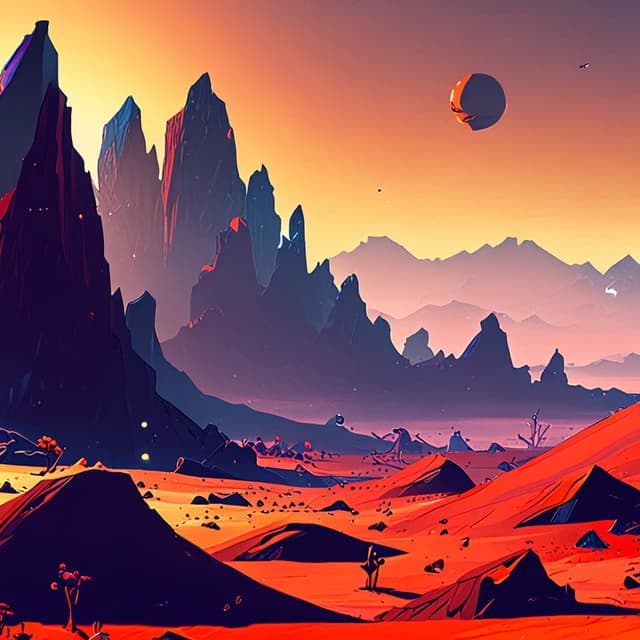
| Genre | Open-world • Procedural generation • Exploration |
| Title | No Man's Sky |
| Platform | PC • Console |
| Developer | Hello Games |
| Description | An early attempt at a procedurally-generated, open-world space exploration game, featuring rudimentary graphics and a focus on survival, resource gathering, and planetary discovery. While not achieving mainstream success, the game built a loyal cult following among dedicated sci-fi and indie gaming fans, and was influential in the development of later open-world and procedural games. |
| Release Year | 1995 |
No Man's Sky was an early attempt at a procedurally-generated, open-world space exploration game, developed by the small British studio Hello Games and first released in 1995. While the game never achieved mainstream popularity or critical acclaim, it developed a dedicated cult following among science fiction fans and independent game enthusiasts due to its ambition and unique approach to world-building.
No Man's Sky was conceived in the early 1990s by Hello Games co-founder Sean Murray and a small team of programmers and artists. Inspired by the pioneering work of Elite and Frontier: Elite II in creating vast, seamless space environments, they set out to create an even more expansive and procedurally-generated universe for players to explore.
Using primitive 3D computer graphics and rudimentary procedural generation algorithms, the Hello Games team constructed a basic framework of planets, moons, asteroids, and alien lifeforms that could be randomly generated on the fly. The goal was to create a sense of limitless exploration and discovery, with virtually no two planets or star systems being exactly alike.
Development was slow and arduous, with the team working with extremely limited computing power and memory constraints. But by 1995, they had assembled a working prototype that could be released as a commercial product.
No Man's Sky was finally released in the summer of 1995 for MS-DOS and early Windows 95 PCs. The game's distinctive lo-fi visual style, featuring low-resolution pixel art, simple geometric shapes, and a muted color palette, was a stark contrast to the more cinematic 3D games of the time.
Critics were divided in their assessment. Some praised No Man's Sky's ambition and the sense of wonder and mystery it evoked, likening it to a "digital planetarium." Others criticized the repetitive and sparse nature of the gameplay, which was largely focused on survival, resource gathering, and rudimentary space combat.
Despite the mixed reviews, No Man's Sky found a small but passionate audience among sci-fi enthusiasts and independent gaming fans drawn to its unique aesthetic and exploration-driven design. It sold modestly well, with an estimated 500,000 copies across its various home computer releases.
At its core, No Man's Sky was a first-person exploration game set in a vast, procedurally generated universe. Players took on the role of a space-faring traveler, visiting and cataloging the countless planets, moons, asteroids and alien lifeforms that populated the game world.
The procedural generation system, while crude by today's standards, was a technical marvel for the time. Each celestial body featured its own unique terrain, atmosphere, flora and fauna, all of which were dynamically created rather than hand-crafted by designers. This allowed No Man's Sky to feature an essentially infinite number of unique environments for players to discover.
Survival was a key element of the gameplay, with players needing to manage resources like oxygen, fuel, and health while navigating harsh planetary conditions. Simple mining and crafting mechanics allowed them to harvest raw materials and construct basic tools and vehicles.
While limited in scope compared to later open-world space games, No Man's Sky's focus on pure exploration and discovery struck a chord with a certain type of player. Its cult following persisted for years, with dedicated fans modding the game and creating fan-made content.
No Man's Sky, while not a mainstream hit, was an influential early step in the development of modern open-world and procedurally generated games. Its innovative technical approach and emphasis on exploration over traditional gameplay objectives inspired many later indie titles.
The game's aesthetic and design sensibilities can be seen in the work of other pioneering sci-fi-themed indie developers like Proteus, Dwarf Fortress, and Minecraft. No Man's Sky's legacy also extends to the latest generation of photo-realistic, AAA space exploration games, which build upon the core loop of planetary discovery and cataloging that the game helped establish.
While its technical limitations prevented No Man's Sky from achieving the blockbuster success of later games, its cult following and influence on the industry cements its place as an important milestone in the evolution of open-world, procedurally generated game design.
